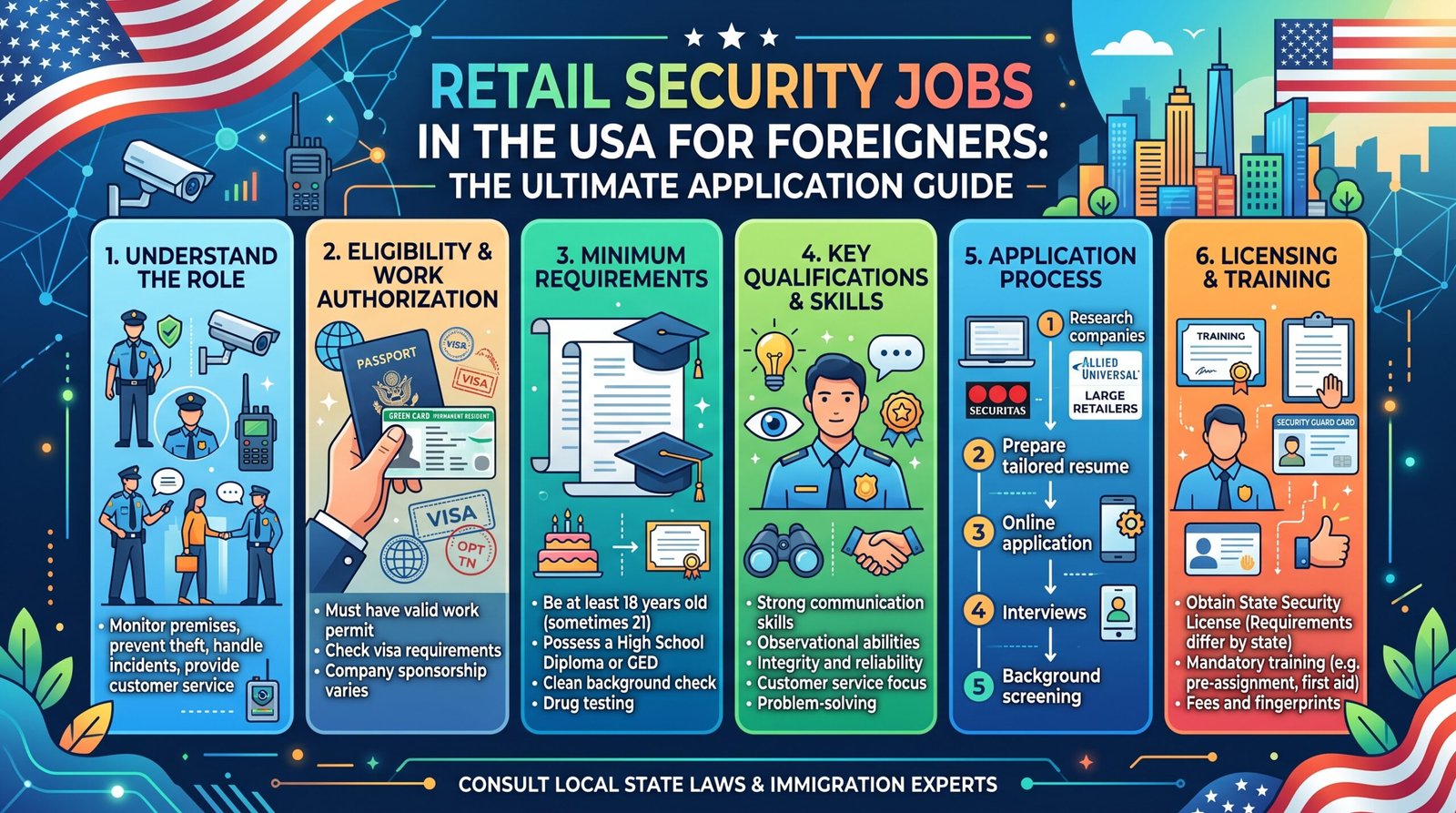
The United States has a massive retail industry, and with it comes a constant demand for security personnel to protect stores, merchandise, employees, and customers. For foreigners seeking work in the U.S., retail security jobs can be a viable entry point—especially because some employers offer visa sponsorship for the right candidates.
This ultimate guide covers everything you need to know: the types of retail security jobs available, visa pathways, top companies that sponsor, step-by-step application instructions, salary expectations, and how to avoid scams. Whether you’re looking for temporary seasonal work or a permanent move, this guide will help you navigate the process.
1. Types of Retail Security Jobs in the USA
Retail security is not a one-size-fits-all field. Different roles require different skills, pay scales, and visa possibilities. Here are the main positions you’ll encounter:
A. Loss Prevention Officer / Asset Protection Associate
- Description: Often works in plain clothes, monitoring customers and employees to prevent theft, fraud, and inventory shrinkage.
- Key duties: CCTV surveillance, floor patrols, apprehending shoplifters, writing reports, investigating internal theft.
- Visa sponsorship potential: Moderate – H-2B for seasonal peaks, EB-3 for permanent roles (rare but possible at large retailers).
B. Uniformed Security Guard (Retail Setting)
- Description: Visible deterrent stationed at entrances, exits, or high-value areas. Wears a uniform and may check receipts or bags.
- Key duties: Access control, customer assistance, observing for suspicious activity, reporting to management or police.
- Visa sponsorship potential: Low to moderate – mostly through security staffing agencies on H-2B visas for temporary assignments.
C. Store Detective / Undercover Security
- Description: Similar to loss prevention but may work across multiple store locations or focus on organized retail crime.
- Key duties: Covert surveillance, building cases against repeat offenders, coordinating with law enforcement.
- Visa sponsorship potential: Low – usually requires specialized experience; rarely sponsored for foreigners.
D. Security Supervisor / Manager
- Description: Oversees a team of security staff, schedules shifts, and implements loss prevention strategies.
- Key duties: Training, incident response, policy enforcement, liaison with corporate security.
- Visa sponsorship potential: Higher for L-1 intracompany transfers or EB-3 if no U.S. workers available. Usually requires prior experience.
E. Security Systems Operator / CCTV Monitor
- Description: Works in a control room, watching live camera feeds and alerting floor staff to suspicious activity.
- Key duties: Operating surveillance software, documenting incidents, coordinating with on-ground security.
- Visa sponsorship potential: Low – but if the role requires technical skills (e.g., IT, analytics), H-1B might be possible (rare).
2. Visa Pathways for Foreigners in Retail Security
The U.S. immigration system limits which visas can be used for security jobs. Most retail security roles fall under “unskilled” or “semi-skilled” categories, meaning the H-2B and EB-3 visas are your primary options. Here’s a breakdown:
A. H-2B Visa (Temporary Non-Agricultural Worker)
- Best for: Seasonal retail peaks (holiday shopping, summer sales, special events).
- Job types: Loss prevention associate, uniformed guard, crowd control in retail.
- Duration: Up to 10 months, with possible extensions.
- Cap: 66,000 visas per year, split between two halves of the fiscal year. Employers must file early.
- Requirements:
- Employer must prove the job is temporary (seasonal, peak load, one-time occurrence).
- Employer must demonstrate no qualified U.S. workers are available.
- Worker must be from an eligible country (most countries qualify, but the list changes; check the latest USCIS or DOS list).
- Pros: Faster processing (3–6 months), lower cost for employer, good for short-term work.
- Cons: Temporary – you must return home after. No direct path to green card (though employer could sponsor EB-3 later).
B. EB-3 Visa (Unskilled Worker – Permanent Residency)
- Best for: Permanent, year-round retail security positions (e.g., loss prevention officer at a large distribution center or flagship store).
- Job types: Loss prevention associate, security guard (if no U.S. workers), asset protection specialist.
- Duration: Permanent – leads to green card.
- Requirements:
- Job must require less than 2 years of training/experience.
- Employer must file PERM labor certification, proving no U.S. workers are able, willing, and qualified.
- Employer files I-140 immigrant petition.
- Worker waits for priority date to become current (varies by country; for India and China, years; for others, 1–3 years).
- Pros: Permanent residency, can bring family, path to citizenship.
- Cons: Long wait times, employer must be willing to sponsor and pay legal fees, limited employers do this for security jobs.
C. J-1 Visa (Exchange Visitor – Intern/Trainee)
- Best for: Students or recent graduates looking for a temporary internship in retail security management.
- Job types: Security intern, loss prevention trainee (often unpaid or low stipend).
- Duration: 12–18 months.
- Requirements: Sponsoring organization (like a designated exchange program) must place you. Usually tied to your field of study.
- Pros: Easier to obtain for young people, cultural exchange experience.
- Cons: Not a direct work visa; limited income; must return home for at least 2 years in some cases (depends on home country and program).
D. L-1 Visa (Intracompany Transfer)
- Best for: Those already working for a multinational retail company (e.g., Walmart, IKEA, Carrefour) in their home country as a security manager or specialist.
- Job types: Security supervisor, regional loss prevention manager.
- Duration: 1–3 years (L-1A for managers, L-1B for specialized knowledge), extendable up to 5–7 years.
- Requirements: Must have worked for the same company abroad for at least 1 continuous year in the last 3 years. U.S. and foreign entity must be related.
- Pros: No annual cap, faster processing, can lead to green card via EB-1C (for managers).
- Cons: You must already work for the company; entry-level retail security doesn’t qualify.
E. H-1B Visa (Specialty Occupation)
- Rarely used for retail security because the job doesn’t require a bachelor’s degree. However, if you are hired as a Loss Prevention Data Analyst or Security Systems Engineer (roles requiring technical skills and a degree), H-1B might be possible. This is a separate category and highly competitive.
3. Top Retail and Security Companies That Sponsor Visas
Not all companies sponsor, but these have a track record (based on Department of Labor data and public records). Always verify current openings.
Large Retailers (Direct Hires)
| Company | Visa Types Used | Notes |
|---|---|---|
| Walmart | H-2B, EB-3 | Sponsors seasonal loss prevention for holidays; EB-3 for distribution center asset protection. |
| Target | H-2B | Seasonal asset protection team members. |
| Amazon | H-2B, EB-3 | Fulfillment center security/loss prevention; strong immigration support. |
| Best Buy | H-2B | Holiday loss prevention specialists. |
| Macy’s | H-2B | Seasonal LP associates for flagship stores. |
| Home Depot | EB-3 (rare) | Asset protection specialists in some regions. |
| Lowe’s | EB-3 (rare) | Similar to Home Depot. |
Security Staffing Agencies (Indirect Hires)
These agencies place workers at retail sites and often have established H-2B programs.
| Agency | Visa Types Used | Notes |
|---|---|---|
| Allied Universal | H-2B, EB-3 (occasional) | Largest security firm; sponsors for temporary retail security assignments. |
| Securitas | H-2B | Sponsors for client sites, including retail stores. |
| U.S. Security Associates (part of Allied) | H-2B | Similar. |
| Prosegur | H-2B | International security company with U.S. operations; sometimes sponsors. |
How to Find Sponsoring Employers
- MyVisaJobs.com: Search for “Security Guard”, “Loss Prevention”, “Asset Protection” in their visa sponsor database.
- U.S. Department of Labor Foreign Labor Certification Data Center: Look up H-2B and PERM filings by occupation.
- H2BJobs.com: Filter by “Security” or “Retail”.
- Indeed / LinkedIn: Use keywords “visa sponsorship security” or “H-2B loss prevention”.
4. Step-by-Step Application Process
Step 1: Assess Your Eligibility
- Are you from an H-2B eligible country? (Check the current list; it changes annually.)
- Do you have a clean criminal record? Essential for security jobs.
- Can you pass a background check in your home country and the U.S.?
- Are you physically fit? Security roles require standing, walking, and sometimes lifting.
Step 2: Prepare a U.S.-Style Resume
- Format: One page, no photo, no date of birth, no marital status.
- Sections: Contact info, Summary, Skills, Work Experience, Education, Certifications.
- Highlight relevant experience: Military, police, security guard, retail, customer service, loss prevention.
- Certifications: CPR/First Aid, security training certificates, CCTV operation, any criminal justice coursework.
- Languages: Bilingual (English + Spanish or other) is a huge plus in U.S. retail.
Step 3: Find Job Openings with Sponsorship
- Search company career pages directly: Walmart Careers, Target Careers, Amazon Jobs, Allied Universal Careers, Securitas Careers.
- Use job boards with sponsorship filters: Indeed (search “H-2B security”), LinkedIn (search “visa sponsorship loss prevention”).
- Use specialized databases: MyVisaJobs, H2BJobs, DOL foreign labor certification data.
- Contact staffing agencies directly via email or phone. Ask about upcoming H-2B or EB-3 sponsorship for retail security positions.
Step 4: Apply and Follow Up
- Apply to multiple positions (20–30 companies) to increase chances.
- Write a tailored cover letter explaining your interest, experience, and that you require visa sponsorship. Example:”I am a security professional with 3 years of experience in retail loss prevention. I am seeking a position that offers H-2B visa sponsorship. I am available to start immediately for the holiday season and have a clean background check.”
- If you don’t hear back within two weeks, follow up politely by email.
Step 5: Interview Preparation
Interviews are often conducted via video call. Prepare for common questions:
- “Why do you want to work in retail security in the U.S.?”
- “Describe a time you detected and prevented theft.”
- “How do you handle confrontations with difficult people?”
- “Are you willing to work nights, weekends, and holidays?”
- “Do you have any physical limitations?”
- “What would you do if you saw a coworker stealing?”
Important: Emphasize that you follow company policy, never use excessive force, and prioritize safety over merchandise recovery.
Step 6: Receive Job Offer and Visa Sponsorship
- The employer will send a written job offer.
- For H-2B: Employer files Form I-129 with USCIS. Once approved, you schedule a visa interview at the U.S. embassy. Bring passport, approval notice, job offer, police clearance, and proof of ties to home country.
- For EB-3: Employer initiates PERM labor certification. This can take months. After PERM approval and I-140 filing, you wait for priority date. Once current, you complete consular processing.
Step 7: Travel and Work
- For H-2B: You enter the U.S. for the approved period, work, then return home.
- For EB-3: You enter as a permanent resident and can work indefinitely.
5. Salary and Benefits for Retail Security Jobs
Salary varies by location, employer, and experience. Here’s a general range:
| Position | Average Hourly Wage | Annual Salary (Full-Time) |
|---|---|---|
| Uniformed Security Guard (Retail) | $12 – $16 | $25,000 – $33,000 |
| Loss Prevention Officer | $14 – $19 | $29,000 – $40,000 |
| Asset Protection Associate | $15 – $21 | $31,000 – $44,000 |
| Security Supervisor | $18 – $25 | $37,000 – $52,000 |
| Loss Prevention Manager | $25 – $40 | $52,000 – $83,000 |
Additional benefits (for full-time employees):
- Health insurance (medical, dental, vision)
- Paid time off (vacation, sick days)
- 401(k) retirement plan (with employer match sometimes)
- Employee discounts
- Overtime pay (time and a half after 40 hours)
- Bonus potential during peak seasons
Note: H-2B workers are entitled to the same wages and benefits as U.S. workers doing the same job. The employer must pay the prevailing wage as determined by the Department of Labor.
6. Common Challenges and How to Overcome
Challenge 1: The H-2B Visa Cap Fills Quickly
Solution: Start your job search in January for the winter season. Employers must file early. Work with staffing agencies that have pre-approved labor certifications.
Challenge 2: EB-3 Processing Takes Years
Solution: If you are serious about permanent residency, begin the process early. Some employers will sponsor EB-3 while you work on H-2B (but you must return home after H-2B ends and wait). Alternatively, find an employer willing to sponsor EB-3 directly and wait in your home country.
Challenge 3: No Direct Experience
Solution: Highlight transferable skills: customer service, cash handling, military/police, or even volunteer security. Get a basic security certification online (like a loss prevention fundamentals course) to strengthen your resume.
Challenge 4: Language Barrier
Solution: Improve your English proficiency. Many retail security roles require interacting with customers and writing reports. Take English classes or obtain a TOEFL/IELTS score to show proficiency.
Challenge 5: Fraudulent Recruiters
Solution: Never pay a recruiter for “guaranteed visa sponsorship.” Legitimate employers pay for the visa process. Verify the company exists, check their website, and contact them directly. Use official government resources to confirm labor certifications.
7. Avoiding Scams: Red Flags to Watch For
- Request for upfront payment: Any fee for “visa processing” or “job placement” is a scam. The employer pays for H-2B or EB-3 filing. You may pay for your own visa interview fee and travel, but not before you have a legitimate job offer.
- Pressure to act fast: Scammers create urgency. Legitimate employers give you time to review the offer.
- No official job offer letter: You should receive a detailed written offer with salary, duties, and location.
- Use of personal email (Gmail, Yahoo) instead of company domain: Legitimate employers use corporate email addresses.
- Request for personal documents (passport, bank info) early: You should not send sensitive documents until you have verified the employer and are in the final stages of visa processing.
- Guaranteed approval: No one can guarantee a visa. Only the U.S. embassy can approve.
How to verify: Contact the employer directly through their official website or phone number. Check the Department of Labor’s H-2B or PERM database to confirm the employer has filed petitions. If in doubt, contact the nearest U.S. embassy for guidance.
8. Conclusion: Is a Retail Security Job Right for You?
Retail security jobs in the USA can be a stepping stone for foreigners seeking work experience, income, or even permanent residency. While sponsorship is not easy to obtain, it is possible—especially for seasonal H-2B positions during the holiday rush.
Your best strategy:
- Target large retailers and staffing agencies known to sponsor (Walmart, Amazon, Allied Universal, Securitas).
- Apply early for H-2B jobs.
- Build a strong resume highlighting security, retail, or customer service experience.
- Stay patient and persistent. The process can take months, but with determination, you can secure a sponsored position.
Remember: The path to working in the U.S. is competitive, but thousands of foreigners successfully obtain retail security jobs each year through H-2B and EB-3 visas. With the right preparation and a bit of luck, you could be one of them.
Good luck with your application journey!